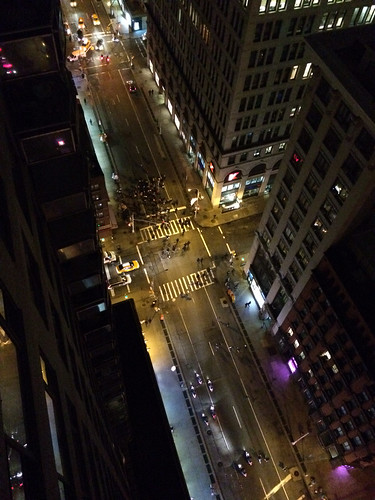
The places we go, when we aren’t going anywhere,

published at 12:09pm on 09/02/07, with 1 Comment

I didn’t have anywhere in particular to go, but I went anyway.

That hasn’t happened to me in a long time. It used to be that I would go out with the express purpose of going out. Not going out to go back in again, but going out to be in the world, to see what the universe had to offer on a particular night, at a particular moment. As I’ve gotten older, or more busy, or more responsible, my desire hasn’t waned as much as my motivation. Motivation, not motivations. Those are still the same. The former though, the former is what keeps me in, glued to the computer or the television, and occasionally to a book. But not often enough to the latter. In fact, as another year slips by, I find that more and more of life is spent in front of one glowing screen or another, doing the things that I do to make the world a better place.

But what do I do to better myself? Alas, not nearly enough. And so, last night, I found myself walking the streets of SoHo as I so often did in the past, with no particular destination in mind, and found myself, as I so often did in the past, sitting on the corner of Broome and Greene streets, watching the world go by.

It wasn’t too late, and the streets were far from filled. That neighborhood never really gets too full anyway. Mostly people passing through, as was the one man who was looking for his car.

“I think it’s on Broad Street. Where’s Broad Street from here? Oh? Not Broad Street. One minute. Honey! Where did I leave the car?”

He walked away for a minute, and I thought about how strange it must be, walking around SoHo, with its large iron columns and cobblestone streets, looking for your car, and coming across a young man, sitting nestled between two columns on the sidewalk, a camera at his side, watching the traffic go past. Do you approach him to ask for directions? Years ago in New York City? Most likely not. But in this, the biggest small town in the world, everyone is as helpful as you want them to be.

“Wooster and Grand! That’s where I left the car. Wooster and Grand!”

I pointed him in the right direction and continued to sit.

The nice thing about not having anywhere in particular to be is that you have the freedom to not have to go anywhere. My butt was getting cold as I was sitting on that big iron step, and at that moment I had a choice. I could stay there, but shift around so my butt wouldn’t get cold any more, or I could get up and move on. The great thing is that I didn’t have to do one or the other - it was an actual, legitimate choice. One wasn’t better than the other. They both had equally compelling arguments in their favor, and it was really just a whim at a given moment that would lead me down one path or another. It’s rare in life that you end up not only with choices but with choices that have such insignificant consequences. It’s quite liberating in fact.

I ended up staying. I shifted into a cross-legged sitting position and remained on the step on the corner of Broome and Greene for a little while longer. While sitting there, I was approached by two more people looking for directions. The first was looking for a sneaker store that was down the block. The second, and older man wearing a t-shirt with a button-up shirt over it, shorts, very long fingernails and a beard, stopped to ask me if I knew where he could catch the 6 train so he could go home. I pointed him in the right direction, and as he was leaving, he stopped and turned back to me.

“I’m taking a bit of a survey. What do you think of the state of the world today?”

I thought this was quite a broad question and asked him to be a bit more specific.

“Well, what about the United States then?”

Now, the first thing you have to remember when engaging with crazy people is that, in general, they just want to talk. They have their own thoughts and their own opinions and their own stories, and they just want to make sure that as many people as possible are exposed to this information. So it’s best to just go with it, if you’re so inclined.

This particular man didn’t seem to have a particular agenda in mind. I told him that I thought that we all need to respect each other a bit more (I, citing littering, was countered by his argument about post-Katrina New Orleans, and a conversation about bottled water were about the only two lucid moments we had together). He looked me in the eyes after a few minutes and said “What’s your name?”

I told him.

“Your last name?”

Again, I told him, though in retrospect, that may not have been such a bright idea.

“I know you. I’ve seen you before.”

“Oh? From where?”

“From, from,” he stammered, and stopped for a minute. “Elementary school. Philadelphia. In the early 90s.”

The fact that I’d not been to Philadelphia until the mid 90s did not seem to deter him, and he pressed on. I was there, he told me. I was in school there. I always had my camera with me. We were part of a commune, my parents and I, and we (from the commune) went to school in Philadelphia. I told him I sounded like I had a good time.

“Oh, you did. You always had your camera, and that’s what you always said - that you had a good time. You were always at the mosque. You know people now. Famous people. Actors and artists. You know them, you’re friends with them. You all went to school together. That’s where I know you from.”

We spoke a bit more about Philadelphia. What did I say my name was again?

“Ka-”

“That’s right. You’ve got it.”

“Ka-. Ker-. Khan… Khan-Miller!”

Well, close enough.

He asked where my parents were living. Haverford? No, I told him. Downtown Philadelphia.

“I’m one of the richest people on the planet, you know? It’s because I made a motion picture when I was two. Mary and the Beetle.”

“And you’re still getting the royalties,” I ventured.

“That’s right. But I don’t get to see any of it. That’s the deal I made before I came to this planet…”

At that point I had to leave, for while I started my evening with no plans in place, in New York City, it’s rare that you can go an entire evening without someone finding something for you to do. In this particular instance, an opportunity for dinner had presented itself, and I had to take leave of my new friend.

“What’s your name, friend?” I asked him, as I was getting up to leave.

“Christopher Wynn, 1786. You know your number, right?”

I informed him that I did not.

“Your BOP number. Ask your parents. They’ll know. Christopher Wynn, the runner.”

“Oh, you’re a runner,” I asked.

“NO! The Runner. So, which way is the subway again?”

And with that, my encounter with Christopher Wynn was over. Was he crazy? Was he just out for a good time? Maybe he was going senile. He’d mentioned that he had been to a photo opening this particular night, and he was just heading home. I don’t recall the photographer’s name, but she was the lover of one or two famous musicians in her time, from what he tells me. He asked if he could come to dinner with me. I told him that unfortunately, it was a closed party, but in retrospect, it could have been the most wonderful night of conversation of my life.

I got up off my perch and headed off to meet my dinner companions. We were the last party seated for the evening and we dined on arepas until we felt like we were going to burst.

20070901D_8858e

Filed under: Personal, Observations, with 1 Comment

Dear Dollar Rent A Car (a complaint),

published at 4:07am on 07/05/07, with 14 Comments

To Whom it May Concern,

I do not like to feel cheated, and I do not like to be lied to by companies to whom I have chosen to give my business. As such, I would like to take this opportunity to share with you an experience I had renting from Dollar a couple of weeks ago. On June 19th, I arrived in Charlotte, NC for a four day long trip. I had booked a car through the Dollar website and was to pick the car up at the airport. The car was available, and as was my usual practice, I informed the agent at the rental location that I would like to decline the insurance offered by Dollar as I know that between my car rental insurance and my credit card insurance, I would be covered.

It was at this time that I was informed by the agent that due to certain laws in North Carolina, I would need to make sure that I was covered for “Loss of Use” of the rental vehicle, in the case of an accident. I informed the agent that I was covered for damages to the vehicle by my credit card, but he assured me that he was intimately familiar with both American Express and Mastercard policies (the latter being the card with which I was renting my vehicle) and that they would definitely NOT cover me in the case of an accident. He recommended insurance that would cover this “Loss of Use,” which resulted in almost $100 added to my rental fee.

Of course when I contacted my credit card company to inquire about “Loss of Use,” I was informed that of course I would be covered, but that by purchasing the insurance through Dollar I had prevented myself from being covered by the insurance provided by my credit card.

I do not expect your employees to be able to make any claims about my person insurance situation. However, when I am told explicitly by your representative, an individual whose job it is to deal with these things every day, that because of specific circumstances in North Carolina, my card will not cover me, I am inclined to believe him. To find out later that this information that I received was just false was to find my trust betrayed and my wallet significantly emptied.

Between the fluctuating rates, gas penalties and insurance, renting a car is one of the most stressful parts of any travel experience. My last experience with your company was certainly a unsatisfactory one, and I would challenge you to think about how you may serve your customers better in the future.

Sincerely,

jcn

Update!

Dollar did right by me and issued me a refund for the insurance portion of my rental bill. Amazing! I was honestly not expecting anything back from them, but I must give their customer service credit for listening to my concern and rectifying the situation in a way that is completely satisfactory to me. Nice job, Dollar.

Filed under: Observations, with 14 Comments

A quarter for your troubles,

published at 5:05am on 05/17/07, with 1 Comment

Customer service is difficult. I understand this. What I don’t understand is how some companies can seemingly go out of their way to make things difficult on their customers.

Let’s take my recent experiences with Bank of America, which I have now decided is the worst bank in the country. It all started when I wanted to start getting my checks Direct Deposited into my Citibank savings account, which I have been using since I was a kid and which has been the recipient of many Direct Deposits in the past. We were told by our Bank of America representative that we could not do a transfer from our BoA business checking account into the Citibank account. Well, inconvenient, to be sure, but easily solved by opening up a Bank of America account at the branch across the street from me. With a referral, I even got $25 for opening an account with them, so I was pretty happy.

So the first thing that happens is that I have a paycheck lying around that I would like to deposit into this account. This is a check drawn on a New York Bank of America account being deposited into the same. I am assured that the check will clear in two days. Two days into the waiting process, I am told that because this is a new account, the check will take longer to clear. Maybe three or four days. Also fine. Inconvenient, but fine. A week into the process, I inquire again as to the availability of my funds and am told that because it’s a new account, the funds won’t be clearing quickly until they “determine my spending habits,” or something of the sort. Not only that, but I am reminded that if I really need the funds quickly, I should cash the check and the turn around and deposit the cash which will be available immediately. Say what?

All of this is moot once I get my Direct Deposit set up though, right? In reality, not. Because what we discover is that our business checking account does not have a feature that lets us do those kinds of transfers. My sister’s checking account, which she uses to transfer money to her roommate to pay her rent and bills, has this feature. But our business account? No dice.

All of this is made even more frustrating by the interplay between Bank of America the centralized corporate entity and Bank of America my friendly local neighborhood branch. Take, for example, the situation where I needed to set up an electronic transfer between my checking account and another bank account (one of those nifty, high interest rate online thingers). I went into my local branch and had a very nice conversation with the representative who told me that I would have to call the bank’s toll free number to get the paperwork that I needed faxed to me before I could set up the transfers. Well, I asked, could I just do it in the branch? After all, I was standing right there. Well, he explained, the branch doesn’t really do that kind of thing normally, but if I really needed the documents quickly, then they could mostly likely accommodate me. So I called the toll free number and was told that the document that I wanted (to set up this transfer, because I didn’t have any checks on my checking account - another bit of absurdity) was going to cost me fifteen dollars. So back I went to visit my friendly neighborhood branch to try to explain in no uncertain terms that I was not going to spend the money just to get a document faxed to me, whereupon I was told that, in fact, the original representative was mistaken, that I did not need this fancy document faxed to me, that they could do it all at the branch and it wasn’t going to cost me a dime.

Total time spent dealing with their misinformation? Three days.

Oh, and finally, finally, to top it all off, I went in to get a roll of quarters the other day and it was clear that it was just a roll that someone had rolled himself and traded in for a ten dollar bill and this person did what we all do when we roll coins to the bank, we leave out a quarter or two because nobody will really notice. Oh, but I noticed. Believe you me I noticed. And I went right back to the bank and told them that I wanted my twenty-five cents that I had coming to me. They looked at me a little funny, asked if they heard me right, that I really wanted to get a quarter back from them that I thought I was due? Oh, I sure did.

And they gave it to me. Wonder of wonders, shocker of shocks, they gave me my quarter.

Now I may just be unlucky. Or I may just be a whiner, but as I walked out of that branch that morning whistling my happy little twenty-five cent tune I thought to myself “You know what? I never want to deal with these fucks ever again.”

Of course I still have my account. Bastards have more ATMs than anyone else after all.

Filed under: Observations, with 1 Comment

We recycle around here. Not!,

published at 2:04am on 04/05/07, with 3 Comments

Recycling does not happen in Las Vegas, as far as I can tell. I’ve been spending some time out here in the past several months, and the home I am staying in has a large garbage bag in the kitchen, and no form of recycling receptacle at all. When I asked about this, I was told that there is supposedly some magical recycling center somewhere in the city, but that it remains completely hidden to mere mortals (and those wanting to not, say, throw out all of their glass and plastic). The dumpsters outside of the apartment are constantly full, and while New York is working on recycling a quarter of its residential waste in the next several years (and has a fully stocked section of its website devoted to the topic), it seems like Vegas would be simply content to landfill anything and everything that was consumed within the city limits. In fact, a search on the city’s official site for anything resembling information for the concerned citizen interested in recycling is a one-pager on Barriers to Recycling in Las Vegas Hotels and Restaurants. No helpful solutions, just a report on why it’s so hard to keep things out of the landfill.

Of course it’s not just the official policy thats the problem - this city, like everywhere else in the US it seems - lives off of plastic bags. Just the other night, I told the woman at the register at Walgreens that I did not need the plastic bag into which she she had just placed the items I had purchased. First came the initial shock of the idea that I wouldn’t want a bag. Next came a fairly aggressive move involving a mock backhand with her hand raised up over her head and swiping down at me. And finally, the nail in the coffin of this planet, when she handed me my items (shaking her head as if to say “my God, the terrorists have already won”) and tossed the bag into the trash can behind her.

I died a little bit inside at that moment.

On the other hand, I have to remember that I am not living on an island here, as I am when I am in New York City. Space is almost limitless, as anyone who has ever driven to the outskirts of this city and seen the acres and acres of condo developments going up out there, stretching out into the desert, can tell you. According to the aforementioned “Barriers” document on the Vegas DEP website, there is actually no market for recycled glass in Las Vegas, and any glass that wants to be recycled needs to be shipped to California for processing and sale. In light of that, it seems to make perfect sense to just throw everything in a hole and cover it with more sand.

I’ve often said that people won’t actually participate in a recycling culture until either a) they are fined for not doing so or b) it becomes part of a product’s life cycle and they don’t even realize that they are recycling. Anything outside a purchase and dispose situation is too foreign for Americans to understand. Fortunately, some companies are actually taking this to heart. I recently learned that Continental recycles the little plastic trays and little plastic containers that hold their salads as part of the salad and cheese pizza snack that they serve (or at least that’s the line that their flight attendants are told to deliver when asked why they are separating out the plastics from the other trash).

Now I understand that it’s a bit counter-productive to talk about recycling while hurtling across the sky in one of the most polluting contributions our society has given to this planet, but given the realities of modern life (which includes at times, the occasional airplane ride), it’s nice to see a company making small strides towards something resembling an environmental good deed. I wouldn’t go so far as to call it “sustainable” by any stretch of the imagination, but just imagine if everyone took a cue from Continental and began to do their part.

There might actually be something left of this planet for my kids.

Filed under: Observations, with 3 Comments

Stranger than Angels,

published at 8:03pm on 03/14/07, with No Comments

I have recently watched two movies that have made me think. That have made me realize once again that there is power in the arts. That have made me understand that we have the ability to think, to feel, to hurt and laugh, all without leaving the comfort of our chairs. And they have made me understand, once again, that these feelings are important. That we, as people, are supposed to feel. Are supposed to think. Are supposed to laugh. And are supposed to hurt. That these are all part of being human. Of being people. Of living life. And that the moment we forget that there is beauty in the world outside of what we ourselves can produce, then we have missed out on the best part of life.

I used to be involved, desperately involved, in theatre. I grew up around art. Oh, not to the extent that many people do, attending the opera, visiting museums, with nightly conversations about expressionism, modernism, or any other -ism that they may be exposed to through their education or their family life. No, my involvement with the arts was in the form of my involvement, from my early teenage years through college, in the production of live theatre. The art of telling stories, on a stage, to an audience. To attend a performance of a powerful piece of theatre is to give yourself over to a story, to empathize with the characters, and to go home with a bit more understanding of humanity (or possibly the lack thereof).

When I was in college, I was involved with a production of the play Love Letters. Traditionally staged as simply a reading, our production was a full-blown play, the two actors performing their roles on opposite sides of the stage, without scripts, in full character. The story is one of unrealized love as it traces the lives of two people, from childhood to death. At the close of the play, we would drop the lights to blackness and in the darkness, begin playing a Sarah McLachlan song. And in that darkness, under the melancholy melody, an audience member would begin to cry. And fueled by the raw emotion of that first, a second would follow, sobbing in the darkness. It was inevitable, it was predictable, and it reinforced in me the ability for the arts to reach in to our chests and rip out our hearts. And it reinforced in me the idea that we, as audiences, do this willingly.

We all like stories. We like telling them and we like hearing them. It is easy in the face of the stories that we are told every day on weekly dramas, on the evening news, on summer blockbusters, to forget that the purpose of these stories, is to learn a bit more about life and the world in which we live. As we gorge on the cultural equivalent of junk food, it is easy to assume that our culture has lost the ability to tell a good story. A compelling story. An important story. A heart-wrenching story. But sometimes, as the credits roll and the lights come up, as the players take a bow and the audience leaves the building, we leave thinking. We leave looking at life through a different lens. We leave wondering, pondering, hoping, and inspired. Or merely introspective. But we leave changed. Not just amped up on adrenaline, and not just chuckling, but truly moved.

Whether or not our future actions are affected by these influences, we remain changed. With the recognition of humanity in the world, we are made that much more complete.

If you have the chance, go see Snow Angels and Stranger Than Fiction. I think you’ll like them.

Filed under: Observations, with No Comments

Complaints on an industry that probably doesn’t need more grief,

published at 11:03am on 03/07/07, with 3 Comments

The problem with most complaints about anything is that they come at moments when we are at our most irritable, our most frustrated, our most inconvenienced. When things go according to plan, when we attempt to operate within the system (for whatever system it maybe in which we are operating) and come out clean on the other side, we have nothing bad to say about a given experience. We asked, we received, and we moved on with our lives. It is most often when we try to deviate from that norm, when we ask the system to be flexible to our needs, that the true nature of the service we are requesting is truly realized.

I am referring, of course, to the state of air travel in the United States today. Over the past several months, I have had the good fortune to sample the offerings of no fewer than three of our nation’s air carriers and have managed to make it through the ordeal with nary a scratch. Of course, in keeping with the original thesis, the trauma comes not from situations where things go well, but when things go, well, less than ideally. The apparent problem that I have encountered recently is that there is no one carrier that can be all things to all people.

Take, for instance, the flight that I am currently on. I am on a United Airways flight from New York’s JFK airport to Maui, with a stop in San Francisco for good measure. Remarkably, from a flight perspective, this one has been relatively painless. After my own brief moment of panic this morning brought on by a malfunctioning alarm clock and an overnight snowfall, I arrived at the terminal to find no line at all at the self check-in. I retrieved my boarding pass and made it to security where I was told that I only had the boarding pass for the first leg of my trip. I hurried back to the ticketing machine where I saw my other boarding pass sitting there, waiting for me. Brilliant planning on the part of the machine manufacturer, I must say, to spit out the second leg boarding pass first, effectively preventing passengers from boarding the first leg without the second leg pass in hand. At security, my luggage required a hand check, and the gentleman handling my belongings was kind enough to put the 10 rolls of film that had looked suspect in the x-ray, right back where he found them when replacing them after inspection. At the gate I was able to change from a window to an aisle seat further up in the plane on both legs of my journey, and once on board, the overhead bin accommodated my roll-aboard suitcase without a problem.

Getting to this point was much more of an ordeal, however. This flight was booked using frequent flier miles and as such, had the benefit of being changeable at any point as long as destinations along the route remained the same. The trouble began when I called to inquire about the possibility of adjusting my flights to return home from Hawaii a few days earlier in order to make a brief stop over in Las Vegas (which is another story all together). The trouble, of course, comes from outsourced phone operators, and the cause of this trouble is a lack of cultural empathy. While call center operators in India and the Philippines have a fluent grasp of the English language, they do not at all have the context in which that language is spoke in the United States, and as such, seem unable to understand which parts of the situation are urgent, which are flexible and when to adjust their tone and inflection when speaking with someone who is already frustrated by being locked into the arcane rules of the airline industry.

In this particular instance, I had never been made clear the difference between a layover and a stopover. From my understanding, as long as I didn’t change any of my travel points, there would be no problem in changing the dates. What I did not understand, and what the representatives were unable to convey to me consistently at all, is that changing planes in under four hours is considered a layover, and over four hours is a stop over. These are different in the computer system, and one is unable to change from one to the other without effectively changing the entire flight. The first representative I spoke with was willing to make the change for me (and did not explain this difference), but I was unable to commit to flight times yet, and told them I would call back. The second representative told me that it could not be done, and berated me for trying to make that kind of change. The third representative finally took the time to explain the difference and the applicable fees.

When I decided to abandon my stop over aspirations, I moved on to the seemingly simple matter of moving my flight earlier by two days. The representative I spoke with informed me that, in fact, those flights were available, and that there would be a one hundred dollar change fee because I was making the change within seven days of travel - another restriction that had never been disclosed when I had asked, explicitly when I booked the flight, whether the dates were changeable. I was further informed that if I waited until my travel was underway, that is, if I waited until after I took the first leg, then there would be no fee, but that there was no guarantee that the flight would be available any more.

I told the representative that none of these fees were disclosed, and that I was certainly not going to pay for this change. Without hesitation, she went to speak with her “resources” and returned a moment later informing me that “we do not charge that fee” and changed my flight without further delay.

In retrospect, the situation was not nearly as bad as it could have been. But it is upsetting to know that these interactions are, by default, judged on how poor they are, rather than how good. I had to speak to at least five representatives before finalizing my itinerary, none but the last who seemed actually interested in helping me come to some kind of positive end to my (albeit outside the ordinary) travel situation.

In contrast to this, just this morning I booked and paid for a JetBlue flight before I realized that I had booked the wrong dates. (A note to JetBlue: please include the full itinerary on the final purchase page of your web site, or at least provide a confirmation before making your customers pull the trigger.) I phoned JetBlue and after only a minute of voice menus, was able to speak with a live human being who first offered to help me find a flight on the day that I actually wanted to travel and, when that search yielded no results at the price I was willing to pay, was able to cancel my purchase completely with no questions asked. It was a brilliant customer service experience if I ever had one.

However, while waiting to take off from JFK on my United flight, we were held at the gate for much longer than anticipated. As the passengers were getting antsy, the pilot came on the intercom system and informed us that a JetBlue flight was “doing that thing that they do” (a reference, of course, to all of their canceled flights on and immediately following Valentine’s day this year) and was preventing our flight from pulling back from the gate.

Immediately, all of that goodwill that they had built up with me evaporated when I was reminded that they have infrastructure problems that they seem to have not fully worked out yet.

Continental has been fine, but really, what the hell is up with that last plane I flew on where the aisle was so narrow that my suitcase didn’t roll through it without scraping each seat as I walked to my seat?

It’s a wonder to me that the airplanes stay in the air at all. That for the cost of a couple of billable hours I am able to fly across the country and back again, with two week’s notice. It’s a wonder to me that the industry is so fragile that one minute a fare can be available and the next moment it will be gone. I think about how the value of an airplane ticket increases and increases until the moment the flight takes off, at which point it is worth nothing.

The airlines would do well to remember that the customers, the passengers, the paid seats are all just people, and people can be remarkably loyal when they are treated nicely. They should remember that there is a fine line between the bottom line and satisfaction, and that the former will suffer with the latter.

There are many complaints to be had, but mostly I am glad that the industry exists at all, for my life would be so much more boring if I couldn’t see the world.

Filed under: Observations, with 3 Comments

A year of significance,

published at 3:11pm on 11/24/06, with 4 Comments

I recently had a birthday, and because my birthday falls towards the end of the year, I tend to equate an entire calendar year to a single year of my life, those two months not withstanding. I mean really, December, in general, is a complete wash, right? No work happens in the second half of the month, and the entire first half of the month is spent thinking about how it’s going to be so nice when nothing is happening in the second half. That leaves the rest of November which, arguably, is a full month, complete with the onslaught of the Northeast’s wintertime jollies, which for the most part just leave me cold and angry at myself for not having bought myself a winter coat. I’ve lived in this part of the country my entire life and the last time I had a winter coat was when my mother bought me one when I was 10.

So now that my birthday has come and gone, I can say with certainty that I am looking forward to this next year of my life. The official end of my twenties is finally here, we are about to tick into a new calendar year, and I can look back and say that my decision to write off almost all of 2006 is probably not entirely unfounded.

At the beginning of this year, I wrote that I wanted 2006 to be a year of significance. Turns out that 2006 was also the year of breakups for me and for seemingly everyone else that I know. Besides the half-dozen or so long-term dating relationships that came apart this year that I heard about (”oh me? Yeah, my boyfriend and I just broke up. What? Oh, six years…”), this was also the year of at least one divorce in my circle as well as a business relationship that just unraveled. More than any other year in recent memory, this one seemed like a year when everything was falling apart, and very little seemed to be coming together. And I, of course, have a theory about this.

We operate on four year cycles. High school is scheduled to last for four year, as is college. Insert your own four year cycle now as I don’t really have any other examples (the Olympics? World Cup?). And I believe I read somewhere that humans do operate, biologically, on a four year cycle, but that’s entirely a lot of bullshit.

The important thing to remember is that four years ago, we were in the middle of 2002. Now 2002 was a funny year. We were all (and I mean, all) coming out of the trauma of 9/11 and the world seemed like a remarkably different place. In 2002, I posit that everything got stuck in time. We, especially the we of the twenty- and thirty- somethings, decided that it was much safer to hole up in our environments as they were at that exact moment in time - say, early to mid-2002 - and just hang out there for a little while. In a relationship? Wonderful! It is safe and it is not going to fall down on you like a big building or a bag of Anthrax. Safety and security trumped everything, and we locked ourselves into our lives.

If that doesn’t float your boat, think about the economic climate of the world (and specifically of the US) at the time. 2002 saw us at the end of the first dotcom bubble, watching businesses implode, watching paper fortunes evaporate and watching jobs vanish. The last startup I worked at was in 2000. In 2001 the last companies in that first wave were just burning through the rest of their seed money and everyone was saying that it was time to grow up, to cut your hair, to get a real job, and leave the business of business to the big boys. And again, everyone locked themselves down with their collective noses to the grindstone and got to work.

Fast forward four years. We are now, four years later, just emerging from our cocoons. The first thing to note is that the calendar made a jump in 2006 to the latter part of the decade. Remember that the early part of any decade is really a continuation of the previous one. Remember the 80s? They really happened in the early part of the 90s. So everything leading up to, say, 2005, was really just a transition out of the late 1990s. Assuming that 2005 was sort of a limbo year for everyone, 2006 is the first time that you can imagine that the end of the decade is actually approaching. Where I live, right near the university, there are students, children, walking around with class of 2010 t-shirts. There is all of a sudden the realization that if I don’t get my act in gear, the thing that I am working on now (that novel, that degree, that start-up company) take any significant period of time, they could bring me into the next decade. Decade. That’s 10 years of my life, missing, gone.

So we sit here in 2006 with this wakeup call that we have just passed the cusp of the middle of the decade are are rapidly running out of time. And all of a sudden people start emerging from the shells that they started building up in 2002 when they were afraid of change. When they were craving safety. And all of those relationships that were formed in the aftermath of tragedy are finally being evaluated on their own merits and in the context of a much longer period of time (”the rest of my life”) rather than in the immediate context of “I really hope I don’t die tomorrow.” And many of those relationships that had their foundations set in that time of uncertainty found that they couldn’t survive outside of that world. People feel free to evaluate their personal relationships for what they are. People feel free to evaluate their professional relationships and are determining why, exactly, they are doing what they are doing. Is it any surprise that 2006 saw the coming of the second Internet bubble? Everyone is finally waking up to their situations and realizing that if they want to move their lives forward, they’d better do it now before the calendar flips again and we find ourselves in the 20-teens.

How significant was this year for you?

Filed under: Personal, Observations, with 4 Comments

Man of the Year: a movie review,

published at 8:10am on 10/14/06, with No Comments

On Thursday night I went to see a screening of Man of the Year, the new Robin Williams movie. Well, at least I’ve been calling it the new Robin Williams movie because all of the previews that I’ve seen for it depict a movie about what happens when a political comedian decides that he’s fed up with our political system and decided to run for office himself. Clearly, hijinks ensue (on scandal: “I did not sleep with that woman. I wanted to…” and on political appointments “Just off the top of my head, I was thinking of Bruce Springsteen, Secretary of State”).

Or at least, that’s what the preview is about.

The movie itself is about something a little different. Read the rest of this entry »

Filed under: Observations, with No Comments

Tags: ,

Port Authority and the Bus to Pittsburgh,

published at 1:10am on 10/06/06, with 5 Comments

New York’s Port Authority Bus Terminal at 11pm on a Thursday night is a dead, depressing place. The only people there are passing through or never leaving, all the restaurants are closed, and the information booths are empty shells of anything even remotely useful. My friend was one of the ones passing through on her way from Boston to Pittsburgh and by the time she is done, she will have traveled for something close to 15 hours on two buses with an hour layover in the Big Apple.

She never actually leaves the bus terminal, but at least she got her taste of the eccentricities of New York City.

Port Authority is home to one of a handful of bowling alleys on the island of Manhattan. The only other one I know of us down in the Village where the NYU students pay a cover to listen to loud music and drink while they throw their balls down the lanes. The Port Authority bowling alley, though updated, is an almost serene place with a bar to the side and empty lane after empty lane, punctuated at times by the local bowling league.

There really is nothing happy about the entire building.

The bowling alley is also closed by 11pm on a Thursday night. The arcade adjacent was open, but our attempts to get a beer at the bowling alley bar were thwarted by the city that, apparently, finds time to sleep. The other bar on the second level of the building, MiLady’s (”meet me at MiLady’s,” the sign out front proclaims) was open, but was filled with bad karaoke, set up inconveniently directly in front of the front door to the establishment, leaving us only to watch momentarily and actually consider going in, until we realized that it was occupied by those who never leave.

We ended up at a pizza/pasta/other food establishment on the ground floor of the terminal eating $2.50 slices of pizza and watching European tourists in matching white hooded sweaters. By the time we left a little past 11:30, the chairs were going up on the tables.

I pity the person who gets stuck in Port Authority over night.

For anyone who’s never actually been in Port Authority at all, I can only describe it as an example of how not to arrange a building for optimal navigation. Where one might describe the flow of people through Grand Central Terminal as a dance, Port Authority is something more akin to a tumble down a flight of stairs. We we reached the bottom of the stairs to where my friend had arrived, a man called out to us.

“Where are you going?” he asked.

He was older, unbathed, carrying a small black nylon workout bag that was tearing at the seams. His black winter coat was tattered, and he was definitely one of the people who called the building home.

“Bus to Pittsburgh,” we responded.

“This way, follow me,” he called back, “this is arrivals, you need departures.”

And we followed him through the terminal, under 41st Street, to the departure terminals. “Don’t be scared. You’re scared. Don’t be.”

“Gate 69,” he said, which was definitely not right as we looked over towards it and found it completely empty. I went to the information booth and asked where the bus to Pittsburgh was departing from.

“Gate 69 or 70,” said the only information booth worker in the entire building.

We walked over to gate 70. On our way, our new friend was standing by the escalator.

“Hey, can you help a guy out?”

My friend gave him a dollar, justified with the notion that “this was a legitimately useful service.”

We wandered over to the gate where my friend was told that the bus was about to leave. Did she have her ticket? (Yes.) Then come this way. (We hugged, and she was led through a closed door to the waiting bus.)

I looked up at the sign above the door.

Gate 69.

The maze of Port Authority is a curse to any traveller, but in the confusion has developed an ad hoc service economy, both out of necessity and opportunity. Like good businessmen, they stand near the entrance to the building, beside the empty information booth, and inquire, ever so gently, “looking for a bus?”

And in that moment those who are just passing through can get a little taste of what New York is all about.

Filed under: Observations, with 5 Comments

BarCampNYC2: Reflections, etc.,

published at 9:10am on 10/04/06, with 3 Comments

This past weekend I had the wonderful experience of watching the BarCampNYC2 event that I had helped organize finally come to fruition. When I attended the first New York City BarCamp in January (almost a lifetime ago with the way 2006 has been progressing thus far), I ended up having such a fantastic time at the event that I decided that I would help make the next BarCampNYC happen.

The interesting thing about the organizational aspects of a BarCamp (or any conference that utilizes some or all of the Open Space Technology techniques) is that the seemingly ad hoc, un-conference is actually planned out to nearly every last detail up until and during the event. Though the structure ends up being fairly loose for the conference attendees, and though the dynamic and the structure of the day may change at any given moment, there is always a team of people at the helm, steering the anarchy, ensuring that it ends up at (or even near) intended goal.

There is plenty to be said about what went right at the event, what went wrong, what could have been done better, and much of that is already broken down on the post mortem page, but I wanted to explore a bit the main thing that I noticed which was this very different “buzz” in the air compared to the first New York City BarCamp, which I will attribute to three things: Space, Communication and Context.

This BarCamp event was held at the Microsoft offices in Midtown Manhattan and the office was absolutely lovely to us, and they definitely just helped to ensure that the event could happen at all (namely, it was one of the only spaces, if not the only one, that allowed overnight stay for the campers). As the company’s sales offices, the space was a collection of conference rooms, surrounding a couple of center common areas, which ends up being perfect for an event like this where you want to be able to mingle with people in-between sessions. I think the only downside to the physical space itself was that there was actually just too much of it. Everyone was able, if they wanted, to find their own corner in which to hide, and I noticed many people grouping off, many times with the people with whom they arrived, and tucking away into a side room or down a hallway, never interacting with other participants.

Now if we were to fully embrace the spirit of BarCamp, we would argue that people are allowed to make of the conference what they will and should be allowed to tuck off into a corner if that’s how they feel they will best experience the event, but at the same time, I would argue that we are going to have to filter out people who are just not interested in fully participating, and participation is a large component of why one would attend, and why the sponsors are paying for, a BarCamp.

Which actually brings me to the next point about the space itself: the draw. The draw that the name “Microsoft” has versus a secret meeting place in downtown Manhattan (which is how the first event was billed) is markedly different. I will simply offer the shoe closet as an example of this difference: I decided not to wear my black, Chuck Taylor Converse All Star sneakers to this event for fear that they would get lost in the pile of other hipster shoes, but what I found instead was a collection of sensible sneakers and loafers, indicating a very different crowd than the one I was expecting. I will not want to blame the space entirely for this, but I do think that an event in Midtown Manhattan will bring in a very different demographic than a downtown one.

In addition, the space brings with it its own group of attendees. When I arrived to set up on Saturday morning I encountered a cluster of MS employees sitting together in the main lounge area. This was a group of engineers who, from all outside appearances, had no idea what they were doing at this event, and were not actually interested in embracing the (arguably froofy) underlying motivations behind BarCamp. One individual had gone as far as to, with a smirk, fill out his nametag “I am a MAN, I am interested in SEX” (the “I am a…” and “I am interested in…” were pre-printed on the name tags). To me, that small gesture, along with the aforementioned exclusivity, and the behavior I witnessed in the actual presentation sessions, was indicative not of any personal shortcoming, but simple a failure to truly internalize, before the event, the type of event a BarCamp really is.

Which of course brings us to my second point, which is one of communication, which I do believe was lacking on the part of the organizers. Again, while an event like this is supposed to be organic, there is some point at which the people making it all happen have to take a step back to see what the attendees are actually seeing and to help get them as engaged as possible leading up to the actual event. In our attempt to keep things loose and free, I think that we missed an opportunity to actually get our hooks into people and make them really excited for BarCamp.

I think the primary shortcoming was simply in making sure that people knew what BarCamp is all about, at least in the broadest sense. While we were immersed in the day-to-day planning of the event, the participants simply had the event website to get all of their information, and up until the event (and even now) the site does not really convey what BarCamp is all about or why you might want to attend. It did not emphasize the attitude that you need to bring to the table in order to really have fun, and I think that it put too much emphasis on one particular part of the participation mantra, namely that everyone needs to present. It did not actively encourage people to help with another presentation or help lead a panel discussion (instead of just leading the typical slides-and-lecture style talk), which resulted in, anecdotally at least, in a number of people not attending simply because they didn’t have a full understanding of what was expected from them.

Finally, there is the matter of context, in a more societal sense, and I don’t think that anyone actually had control over this part of the day. We are eight months down the road from the last BarCamp event, and a lot in the world has changed. A lot of the people who were looking for work, who were exploring projects on their own or who were just starting their own companies are now solidly entrenched in the daily day-to-day of the work, and when that happens, a lot of the gleam can come off of one’s vision of the world. And instead of being stuck in the middle of winter, with the prospect of spring on the horizon, we are now at the end of the summer, with only the prospect of a cold and rainy autumn on the horizon, which too affects the overall mood of the participants. Again, this context was mostly unavoidable, and I’d be curious to know if there could have been any way of harnessing it, but I think that it’s important to at least acknowledge its existence as an outside influence.

BarCamp is a free event, and while it is open to all, it is really only open to people who are open to it. Attendees who are not ready to experience it, and who are not willing to let go of their preconceived notions of what a technology conference should look like will not only have a bad time, but will also bring down the buzz of everyone around them. While I do not think that this happened at this event, but I do feel like the energy level was not as high as it potentially could have been. I firmly believe that the un-conference aspect of the event applies to the planning of it as well, and I am excited to take the lessons that we learned this time and apply them to future BarCamps, either in NYC or beyond.

Filed under: Observations, with 3 Comments